

2026 is around the corner, and AI is anything but a shiny new toy.
AI content creation and search have flipped the proverbial table. What we do, and how we do it, has to change. Teams that once chased publishing quotas are asking harder questions about differentiation, expertise, and audience relationships.
We surveyed 153 content leaders with this in mind. And the signal from the front lines is clear: when content is everywhere, credibility becomes the strategy.
Who we surveyed
To understand where content marketing is actually headed, we surveyed 153 professionals actively responsible for content outcomes.
Respondents included:
- 83% content strategists, with the remaining 17% spanning marketing managers, founders, and senior content practitioners
- Companies ranged from small teams to large, established organizations, giving us insight across growth stages
- 100% are directly responsible for planning, creating, or scaling content
What we asked respondents
We focused on three core areas:
- How our content strategies are shifting
- What helps or hurts when publishing high-quality content at scale
- Where AI fits — and where it falls short
- What will actually determine content success over the next 12–18 months
This data reflects the day-to-day realities of people accountable for content performance right now.
Key findings
- Improving search visibility and driving conversions remain top content goals, with pipeline or conversions being the top success metric (88% of respondents)
- Authority and trust now outweigh speed, volume, and search visibility for content success (nearly 80% of respondents).
- AI is universal: 100% of respondents use it, but confidence depends on human oversight, not automation.
- Workflow inefficiency is the top operational bottleneck to scaling high-quality content (70% of respondents).
- Teams are not removing quality controls; they are seeking clearer, more intentional approval pathways that protect credibility without stalling production.
- The competitive edge in 2026 will come from systems that scale expertise, not content output.
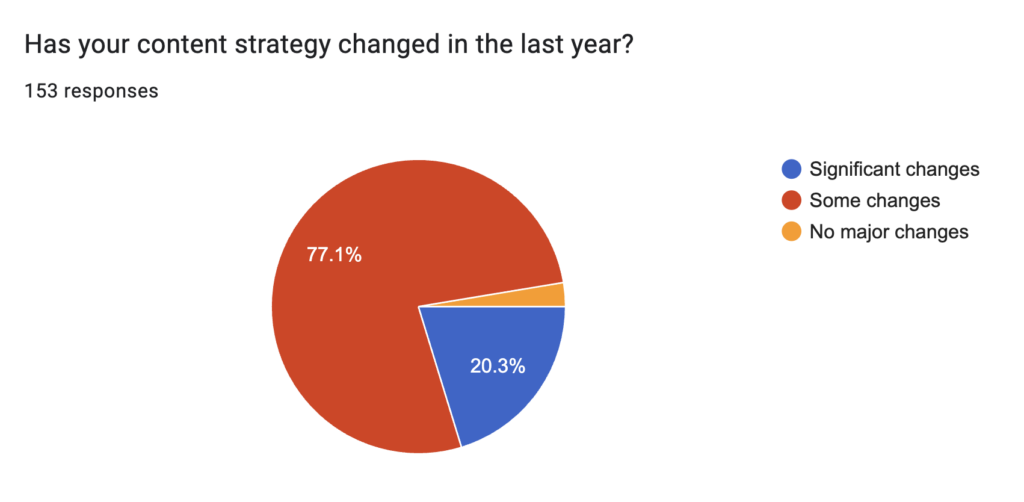
What we do, and how we do it is changing — 77% of respondents say their content strategy has already changed, and 20% report significant strategic change over the past year.
Trust & authority are no longer optional
When we asked what will matter most for content success over the next 12-18 months, the answer wasn’t speed or volume. Nearly 80% chose “authority and trust.”

“Trust is everything. It does not matter how beautiful or well-written your content is if it does not resonate with your audience on a personal level or offer them genuine value.” — Joshua Locke, Creative Marketing Professional

This doesn’t mean abandoning search visibility or revenue outcomes. In fact, improving search visibility and driving conversions remain core goals, with nearly 90% measuring content success by its pipeline impact.
What’s changing is how teams achieve those outcomes. Rather than relying on volume or optimization alone, content leaders see authority and trust as the inputs that make it possible.
This mirrors what many teams are already feeling:
- Audiences are more skeptical
- AI content is everywhere
- Google (and LLMs) are rewarding expertise
As Rebekah Glader , Marketing Leader and Creative Strategist, put it: “As AI becomes more common and content becomes more accessible, we lose the ability to be different. Clients need to lean into what makes them unique, what only they can say.”

In a world where anyone can publish endlessly, differentiation comes from having something real to contribute.
AI adoption is high, but confidence is lagging
Content teams aren’t afraid of AI. 100% of respondents use AI in some part of their content process, with almost 74% using it extensively.
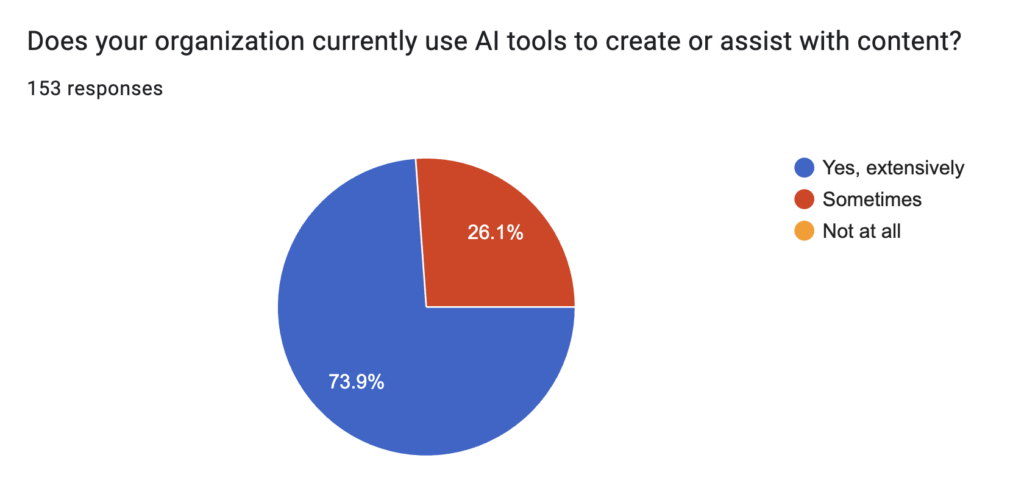
The technology is there, sitting in browser tabs and integrated into content management systems. But the confidence that it’s actually helping teams create better content? That’s another story.
Adoption doesn’t equal trust. When asked how they ensure AI-assisted content remains credible, Over 80% rely on SME review, formal fact-checking, or both. Nearly half use a layered approach, combining expert review, fact-checking, and internal AI guidelines.
Teams want AI that works with these flows. A theme across responses was a desire for tools that can:
- Speed up research and drafting
- Support expert-led insights
- Cut collaboration friction
“Quality checks and balances are going to be key. AI can expedite the initial stages and help get ideas flowing, but a human should always be touching it from a brand perspective.” – Lauren Majid, Associate Director in Content Marketing

Eliminating workflow friction
Here’s the tension: Marketers know authority matters, but authoritative content is hard to scale. Nearly 70% of survey respondents said that a better workflow would help them confidently publish high-quality content at scale.
It’s no coincidence that the most cited barrier in the survey was execution. Collaboration across teams and SMEs introduces delays — but teams aren’t willing to sacrifice review:
- 90% maintain some form of structured review process
- Less than 6% report having no defined review process

It’s a tangled web when the systems designed for quality are the same ones grinding production to a halt.
Clearer pathways for approval
Success can look like reduced steps, and laser focus on the work that meaningfully impacts final quality.
Baba Hausmann, SEO Strategist, says, “It’s no surprise that inefficiency is the leading cause of quality issues. I see this daily: teams have the strategy, but the execution pipeline is broken.”

Hausman says that to streamline processes and guarantee quality in 2026, teams must master what he calls the Content Intelligence Trifecta: deep alignment on Product, Market, and Audience.
- The Product: Your internal baseline. Teams often face bottlenecks here because they rely on Subject Matter Experts (SMEs) too late. Build a knowledge base and use proactive intake systems to extract internal expertise before you start writing.
- The Market: This goes beyond basic SEO. It’s about analyzing the competitive landscape, both direct and search competitors, to understand the vocabulary they use and the narrative gaps they leave behind.
- The Audience: This is the most complex. Aggregate internal signals (data from Sales, Support regarding pain points, and other sources) and external signals (unfiltered discussions on Reddit, G2 reviews (yours and competitor), or even read interviews with competitor CEOs to spot industry-level shifts).
The hard truth — it’s not a band-aid
According to Hausman, the teams he works with have production timelines from months to weeks. But they don’t work for every company. To make the changes, most need to go through a fundamental cultural shift — and admit that the current way isn’t working
It’s a comprehensive effort that impacts everyone, from marketing to technical reviewers.
“It requires investment. You may need to hire specific roles or allocate budget to fix the process. If a company is not willing to pay the cost of change, the results will not follow.” — Baba Hausman, SEO Strategist
AI is only as strong as our inputs
AI has become a full-blown content partner. But what we get depends entirely on what we give.
“The rule is simple: Garbage In, Garbage Out. If you feed your content engine high-quality inputs, you can leverage AI to differentiate yourself and win. If you do not, you are simply generating noise faster.” — Baba Hausmann, SEO strategist
Our survey data agrees. While AI adoption is universal, nearly one in four respondents (22%) say better access to industry-level experts would help them confidently publish high-quality content at scale.
That signal matters because it points upstream from drafting tools toward inputs.
AI can’t manufacture authority. It recombines what it’s given. When expert insight, real experience, and clear point of view are present early in the process, AI becomes a multiplier. When they aren’t, it simply scales sameness.
This helps explain why over 80% of teams rely on SME review or fact-checking even as they push for faster workflows.
“AI can help with the efficiency of writing and video editing, but you still need to think about the audience and the message. Otherwise you risk becoming a content factory that does not drive any business value.” — Tomas Melian, Business Executive and Marketing SVP

AI has no problem creating for creation’s sake. It’s up to us to make sure that content reflects something worth trusting.
Balancing quality & quantity
When it comes to volume and quality, we can’t afford one over the other. 90% of respondents said that improving search was their top-priority, while increasing content production was at 75%.

With the rise of LLM-based search, search really is everywhere. We’re chasing citations, mentions, and overall brand visibility. When asked how important it was that their content be citable, 68% said extremely important.
But that doesn’t mean posting blind. Authority and trust were ranked as the most important drivers of content success.
Instead, we need a more intentional approach to scale — where teams concentrate effort on fewer, high-impact pieces while using AI to support, not dilute, substance.
“Content marketing needs to evolve from mass production to strategic depth. Audiences reward nuance and expertise, not noise.” — Yogev Kimor, Content Marketing Leader

This is especially clear for smaller teams and solopreneurs, where resources are limited and credibility is often the strongest differentiator.
“Focus on solving real problems with depth and authenticity, even if it means publishing less frequently.” — Dori Zinn

Sustainable content engines are built on systems. Our teams can move beyond ad-hoc reviews to a structured, scalable process.
One thing is for sure: We shouldn’t choose between volume and substance, so let’s build the frameworks that deliver both.
Hybrid intelligence frameworks are on the rise
So, how can AI and humans work better together?
On one hand:
- 100% of respondents use AI
- 74% use it extensively
On the other:
- Over 80% rely on SME review or formal fact-checking
- 22% say better access to industry-level experts would help them publish high-quality content at scale
This points to a hybrid reality. AI is deeply embedded in content creation— but authority still depends on human insight.
“Why rely on outside perspectives when the real nuggets of gold and true industry expertise already exist in-house? Think: the CEO, CFO, sales team… who are undoubtedly busy, but that is exactly where AI comes in to make the process more efficient.” — Georgia Austin, Wordbrew CEO

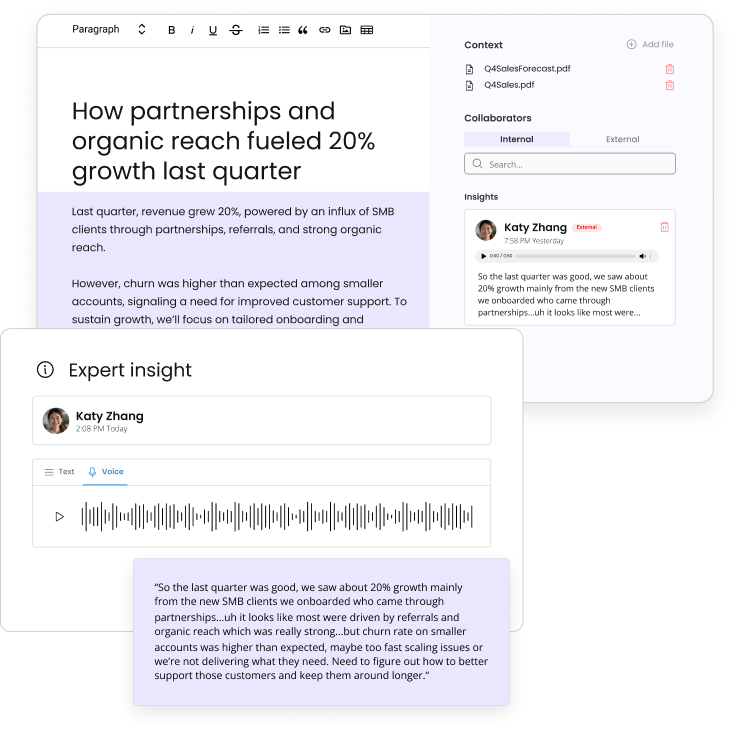
Wordbrew was designed to tackle this. The hybrid intelligence framework captures expert insights asynchronously and turn them into unique content — letting AI make the first draft.
It’s on us to build that niche knowledge: focusing extensively on our own industries, functions, and audience needs. This let’s us build our own unique insights. And those insights are gold.
“I believe that everyone must spend time developing critical and creative thinking skills to thrive in the AI era.” — William Siebler, Marketing Manager

AI works best when it’s paired with real experience, clear point of view, and intentional review. Wordbrew gives us a flow that combines these levers naturally:
- Collecting expertise first
- Executing with AI
- Streamlining human review
This way, scale doesn’t have to come at the expense of trust.
What success looks like in 2026
Our survey makes one thing clear: content leaders are rethinking how we achieve success — even as the metrics remain grounded in business outcomes.
Improving search visibility and driving conversions or pipeline remain core goals, with nearly 90% of respondents measuring content success by its impact on revenue.
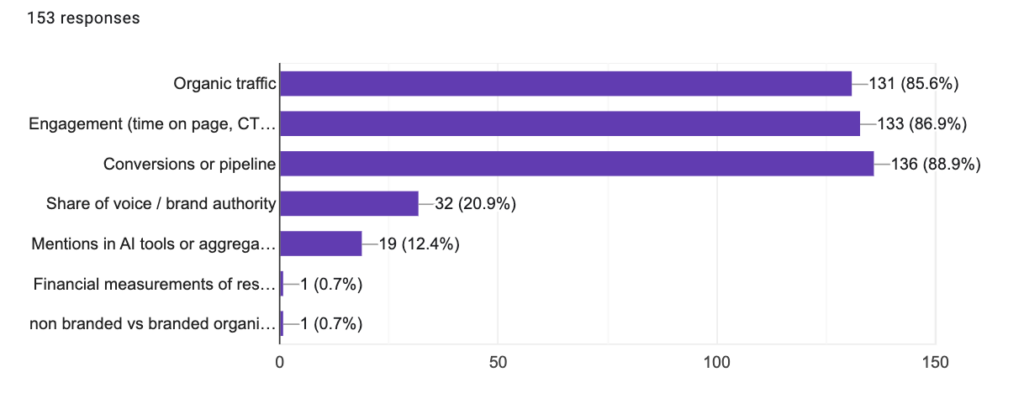
But the data shows a shift in what we think drives those results.
Rather than prioritizing speed, volume, or channel-specific optimization, nearly 80% of respondents point to authority and trust as the most important factors for content success.
As Brandon Newkirk, 3x VP of Marketing puts it:
“Authority is not measured in page views anymore. It is measured in how often your insights shape the conversation, how frequently your content gets referenced by peers, and how confidently prospects cite your expertise in sales conversations.”

This reframing matters because where and how people discover content is a brand new ball game.
“The way people find and consume content has completely shifted. Everyone wants answers fast, and a lot of the traffic that used to go to blogs is now being swallowed by AI summaries or instant snippets.” — Lakshmi Padmanaban, B2B Writer and Strategist

It’s not about winning a single platform. It’s about showing up with credible, human insight in the moments and places where your audience is already paying attention.
“Stop thinking only in terms of platforms and think of the audience. Where is your reader scrolling, listening, or watching when they are most open to hearing from you? Let your brand sound human again.” — Lakshmi Padmanaban, B2B writer and Strategist
In 2026, we’ll earn real trust, meet people where they are, and say something worth hearing.
When content is everywhere, credibility wins
“The thing that does not change, even when technology does, is core human nature.” — William Siebler, Marketing Manager
AI made content easy. It didn’t make it meaningful.
That’s why credibility is your number one growth strategy.
In 2026, search visibility and pipeline still define success. Authority and trust are what get us there.
With AI embedded in every workflow, it’s time to strategize around the experts at the helm. The most effective teams are designing systems that make expert insight a core input.
AI can only amplify what’s already there. Credibility determines whether we’re creating value or noise.
